

Jane Ira Bloom & Brian Shankar Adler – FYC

FOR YOUR CONSIDERATION
Please consider once like a spark by Jane Ira Bloom & Brian Shankar Adler for Best Jazz Instrumental Album.
Listening links:
Jazz Master Jane Ira Bloom Teams With Experimental Drum Virtuoso Brian Shankar Adler On New Album once like a spark
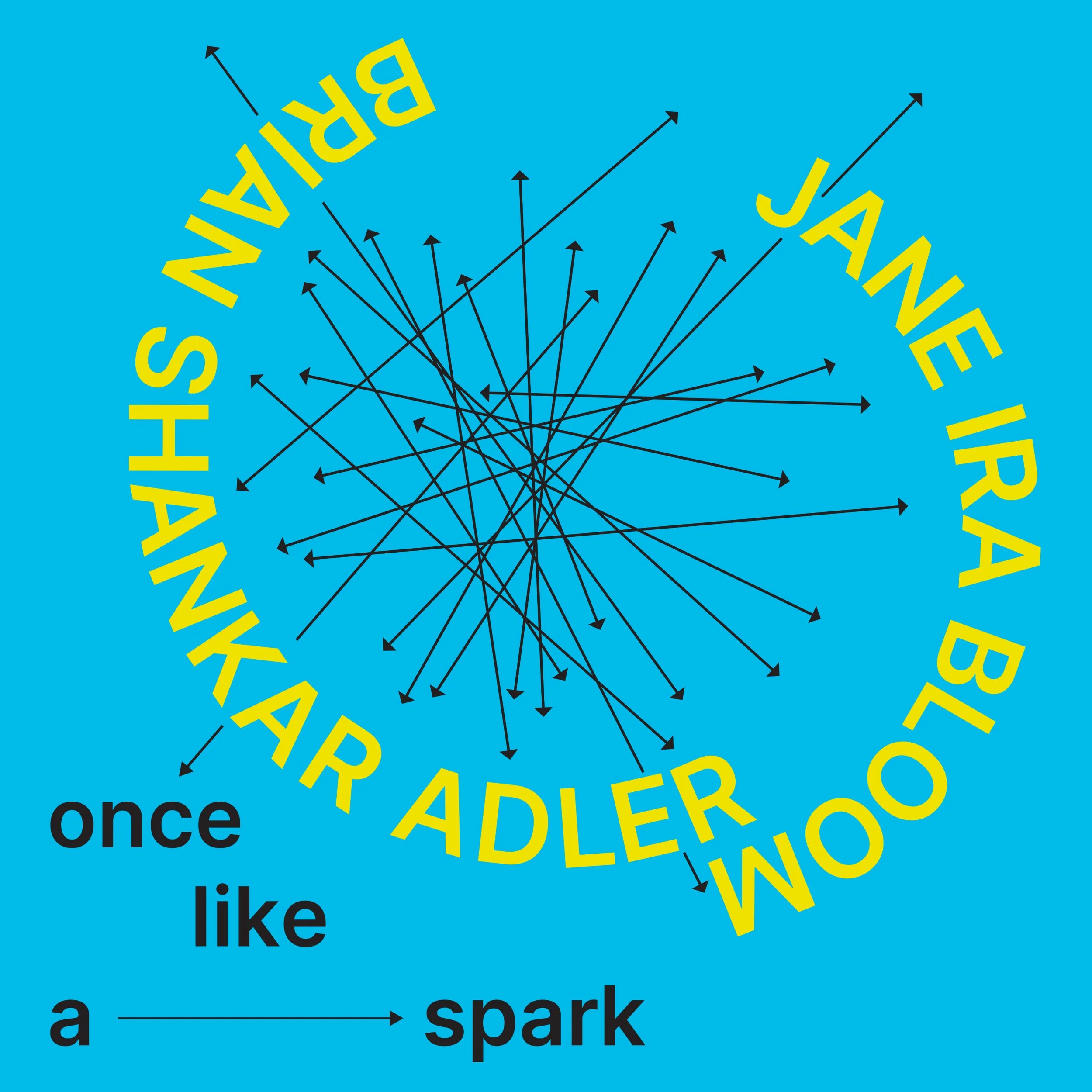
Adhyâropa Records is thrilled to announce once like a spark, the new collaboration between legendary saxophonist Jane Ira Bloom and forward-thinking drum sensation Brian Shankar Adler.
once like a spark brings together NASA soprano saxophonist/composer Jane Ira Bloom and percussionist/composer Brian Shankar Adler for a series of acoustic duets that traverse the globe and showcase their unique improvisational magic. After years rehearsing and performing together they decided to go into Acadia Studios in Portland, ME in July 2025 to record their collaboration. The result is 14 tracks that document the spark of their extraordinary connection. Many of the tracks are first takes of pieces whose inspirations range from the gamelan of Southeast Asia (‘Shan Dara,’ ‘Together We’) and rhythms of North India (‘Psalm,’ ‘Song for Khan’), to literary icons Jorge Luis Borges (‘A Boa a Quq Aoaba’) and e.e. cummings (‘once like a spark’), to the galaxy & beyond (‘Old Orchard Intergalactic Launchpad,’ ‘Air’). The music is alive with rhythm, melodic soul, and turn-on-a-dime improvisation. These duets are intimate acoustic snapshots of two master improvisers at play in celebration of music that explores the planet and beyond. Their sound is both warm and dynamic, and fired with rhythm. It’s almost hard to believe that there are only two musicians playing as each of the tunes unfold improvisations that tell a unique tale of sonic adventure. once like a spark ignites a special one-of-a-kind rapport between two seasoned improvisers at the height of their powers.
About the Artists:
Soaring, poetic, quick silver, spontaneous and instantly identifiable are words used to describe the soprano sound of saxophonist Jane Ira Bloom. She's been steadfastly developing her singular voice on the soprano saxophone for over 40 years creating a body of music that marks her as an American original. She is a pioneer in the use of live electronics and movement in jazz, as well as the possessor of "one of the most gorgeous tones and hauntingly lyrical ballad conceptions of any soprano saxophonist (Pulse)." She’s recently focused her attention on recording in surround sound and is a winner of the 2018 Grammy Award for Best Surround Sound Album for her trio album Early Americans and a 2023 Grammy nomination for Best Immersive Audio for her duo project Picturing the Invisible: Focus 1. Her latest critically acclaimed release Songs in Space featuring Mark Helias, Bobby Previte and Dominic Fallacaro received 4 stars from Downbeat Magazine.
Her continuing commitment to "pushing the envelope" in her music has led to collaborations with such outstanding jazz artists as Kenny Wheeler, Charlie Haden, Ed Blackwell, Rufus Reid, Matt Wilson, Bob Brookmeyer, Julian Priester, Jerry Granelli, Billy Hart, Mark Dresser, Bobby Previte, & Fred Hersch. She's also spearheaded collaborative world music groups featuring world music virtuosi Min Xioa-Fen on Chinese pipa, South Indian veena artist Geetha Ramanathan Bennett, koto artist Miya Masaoka, Korean komungo player Jin Hi Kim, and bassist Mark Dresser. She has performed at such diverse venues as Carnegie Hall, Jazz at Lincoln Center, the Museum of Modern Art, the Kennedy Center, the United Nations, the Cathedral of St. John the Divine, the Smithsonian's Einstein Planetarium, the Montreal, JVC, and San Francisco Jazz Festivals as well as regular concert engagements in NYC.
A multi-time winner of the Downbeat International Critics Poll for soprano sax, the Jazz Journalists Award for soprano sax of the year, the Mary Lou Williams Women In Jazz Award for lifetime service to jazz, the Charlie Parker Fellowship for Jazz Innovation and the International Women in Jazz Jazz Masters Award. Bloom is the first musician ever commissioned by the NASA Art Program and was honored to have an asteroid named in her honor by the International Astronomical Union (asteroid 6083janeirabloom). She's garnered numerous awards for her creativity including a Guggenheim Fellowship in music composition, a residency at the Baryshnikov Arts Center, a grant from the NYC Womens’ Fund for Music, Media, & Theater and a grant from New Music USA.
JIB has participated in several international and 'remote' events directed by composer Sarah Weaver including a large ensemble performance at the United Nations that linked improvising musicians in Korea, China, New York, and San Diego. Bloom continues to find inspiration in creating exploratory music with improvising musicians from around the world. She has recorded and produced 22 albums of her music dating from 1977 to the present. In 1976 she founded her own record label & publishing company (Outline Music) and later recorded for ENJA, CBS, Arabesque, Pure Audio, and Artistshare Records. Bloom has been the subject of a number of media profiles; she has been featured on CBS TV's Sunday Morning, Talkin' Jazz on NBC-TV, TIME Magazine's Women: The Road Ahead special issue, in Vanity Fair, in Life Magazine's "Living Jazz Legends," on NPR's Morning Edition, Jazzset, Live From the Kennedy Center w/ Dr. Billy Taylor, and in the documentary film Reed Royalty hosted by Branford Marsalis. She is a professor at the New School's College of the Performing Arts School of Jazz & Contemporary Music in NYC. Nat Hentoff has called Bloom an artist "beyond category." Bill Milkowski has called her "A true jazz original...a restlessly creative spirit, and a modern day role model for any aspiring musician who dares to follow his or her own vision."
Bahar Movahed’s new album Together Yet Alone is a unique and beguiling project, in terms of both purely musical values and backstory. The Iranian-born and now California-based singer, releasing her first album since the acclaimed 2012 album Goblet of Eternal Light, has created a passionate and unprecedented ode to her Persian classical roots, with great reverence for the ancient radif tradition and in resourceful defiance of Iran's restrictions on female singers in public.
Special circumstances allowed for the album to materialize, including the long-distance California/Tehran collaboration and her fateful partnership with respected Iranian composer Navid Dehghan, one of the most respected classical musicians and composers in Iran. During the COVID-19 lockdown, Movahed carefully crafted new music over a year of rehearsals with Dehghan through WhatsApp, flying to Tehran in November of 2021 for three days in the studio with his accomplished 14-piece Ghamar Ensemble.
Goblet of Eternal Light was recorded with the master Kurdish tanbour musician Ali Akbar Moradi back in Iran, released only after Movahed migrated to the United States in 2010. Although the album was well-received by critics and listeners, she clarifies that “my first album was in Kurdish, but this is my first solo album in Farsi, my own language. I really wanted to showcase what I learned during the last 20 years.
“You want to still show all the emotion and the spiritual journey of this music and you want to transfer that message. That’s what the whole ensemble and Navid have been trained for and also have been striving to do. They're trying hard to keep this music alive.”
Movahed, who studied with revered vocalists Parissa, Shahram Nazeri, Hamid Reza Noorbakhsh and the legendary Mohammad Reza Shajarian in her early years in Tehran, is presently an orthodontist by day, in Orange County, California. Creative talents include playing piano, the Kurdish tanbour and various instruments, and a visual arts sideline as a gifted caricaturist. But her deepest love remains classical Persian music, a pursuit she devotedly worked at, and found herself thwarted in, while in Iran.
As Movahed explains, “I'm one of thousands of women whose passion is singing, but they are silenced. The love was so big that I just kept learning, knowing that, in Iran, you could perform only as long as you were a backing vocal or you sang in a way in which men's voices were basically blocking your voice. That was not my ideal. That was not what I was learning the music for.
“This music is so fulfilling and it's so spiritual and soulful to me. Sometimes they say love doesn’t save you, but art does.”
After completing her dental studies and establishing herself in California, Movahed performed some in the U.S. But she mostly kept her deeper musical ambitions in check, until the urge to explore those ambitions turned serious in 2019, a decade after recording her debut album. Further delays prolonged the process, from the creative gestation period with Dehghan and the two-year search for a record label, which they found in the open-minded, artist-run Adhyâropa Records. The label will release the album on May 29.
Among other significant aspects of Together Yet Alone, the album represents a first for a female singing in Rast-Panjgah, the most complex and challenging of the seven different modes in the dastgāh system of Persian music.
During the evolving process of the back-and-forth between the singer and composer, Movahed comments, “all of a sudden Navid sent me just a few lines of the song ‘Together Yet Alone.’ I said ‘this is it. This is the centerpiece of our album, and the rest of the album should go around that.’ I could connect to it immediately, and I knew that many people could feel the same.”
The album’s program is a cohesive yet diversified set, from the rhythmically open “non-metric” pieces “In Grace of Light” and “Your Lips,” sparsely backed by Alireza Geranfar’s santour and Dehghan’s kamancheh, to the larger ensemble formats of the title piece, “Minstrel” and the joyous closer “Jest.”
In terms of texts, sources go deep. “We used the lyrics of eight centuries,” Mohaved explains, “from Rumi and Saadi to modern poets like Sayeh and Siavash Kasrai. The message is that whenever you read those poems, it's timeless. And this genre of music is timeless. If we preserve this tradition and this music, it always finds its way to the right audience.”
Movahed is moving into the video realm with her music, as well. For director Nilofar Zubihi’s animated video for “Crack of Dawn,” she explains, “it was mainly the artist’s interpretation of our music,” whereas the singer was more directly engaged in the creation of the story-allusive video for “Together Yet Alone.” Mohaved was happy with the results, allowing that “you always have that fear, like when they make a movie out of a novel that you loved,” she laughs.
Movahed’s achievement will go unreleased in Iran, and current difficulties of international travel prevent live performances with the ensemble, although European dates may be possible. But the recorded evidence is available and documented.
Movahed asserts “I just want the music to be heard. I hope that I can be a voice of so many women who are not being heard. Basically, with this music, I’m saying I am surrounded yet I'm alone. I'm broken and I’m full of hope. I think that could be a feeling of the nation, and also women in that country. The music says ‘I'm grieving, and yes, I'm alive.’
“We hope we can find that platform to perform this music in Iran. But, as we speak, we can't even plan a concert with these musicians in the U.S. For now, I'm just happy that the album is released after all the difficulties and after all the delays. I really hope that it can be heard and people can feel the love that we put in this album, in every single part of it.”
Brian Shankar Adler is an interdisciplinary percussionist and composer. Described as "a polyrhythmic force… New York City gritty yet still somehow capable of evoking the delicacy of a summer breeze…” (JazzTimes), his work transcends the terrain between genre and geographic region.
Adler has performed internationally, in caves, forests and adjacent glacial ice fields as well as Carnegie Hall, Lincoln Center and The Stone. He has been recorded on over fifty albums including his solo works: Echoes of the Gomero (Adhyâropa Records, 2025), For a Gallery on the Moon (Chant Records, 2020), and Fourth Dimension (Chant Records, 2019).
Playing primarily a hybrid drum set that includes North Indian tabla, Argentine bombo legüero and an array of found objects, Adler's work explores the perception of time, the communicative properties of gesture and the anthropogenic footprint on regional ecosystems. With equal focus on improvisational and compositional practices, he uses rhythm as a tool for collaboration.
An accomplished composer, Adler’s works have been praised as “profoundly exquisite… striking interior chords, where the heart and the mind's inner ear intersect..." (All About Jazz). He has been commissioned to compose A Memory of Fire (Palaver Strings), Echoes of the Gomero (Rasa String Quartet), and We Are a Body of Water (Bates College Gamelan Orchestra). A 2025 CASJ Fellow, Adler collaborated with scientists at the Shaw Institute to create Dance of the Cephalopod, a solo percussion installation that explores innovative ways to engage the public through social justice. Adler was a composer-in-residence at Antenna Cloud Farm, Avaloch Farm Institute and Vermont College of Fine Arts. He has been the recipient of numerous awards, including Composer's Now Grants and ASCAP Plus Awards.
Brian Shankar Adler has toured, performed and recorded with Ballet Hispanico’s Doña Perón, Kamala Sankaram’s operas Thumbprint (LA Opera), A Rose (Houston Grand Opera) and The Jungle Book (Glimmerglass), César Alvarez's Egg (Lincoln Center) and Elizabeth Swados’ final theatrical productions The Nomad and The Golem. He traveled to Germany to perform with singer Sunny Kim and Kuwait to perform with oudist Ahmed Alshaiba. Adler has been featured in Jason Bivins’ book "Spirits Rejoice," The Center For Deep Listening's "A Year of Deep Listening," NPR's "New Sounds," PBS's "Next at the Kennedy Center'' as well as Downbeat and Modern Drummer Magazine. His music video, “Mantra” won best music video at Transcinema International Film Festival in Peru and an official selection at Quiet City Film Festival in New York City.
In 2013, Brian Shankar Adler was the guest soloist with La Bomba de Tiempo in Buenos Aires, Argentina. He returned to the states to create Human Time Machine, a percussion ensemble that would hold a three year residency at Barbès as well as performances at the Queens World Fair and Roulette Intermedium. Adler has also worked with: Kinan Azmeh, Jay Clayton, Jane Ira Bloom, Guillermo Klein, The Michael Leonhart Orchestra, Frank London, Kate McGarry, Matt Moran, Mali Obomsawin, Emilio Teubal and Ray Vega. He is a member of Bombay Rickey and performs environmental activism with Bash the Trash.