
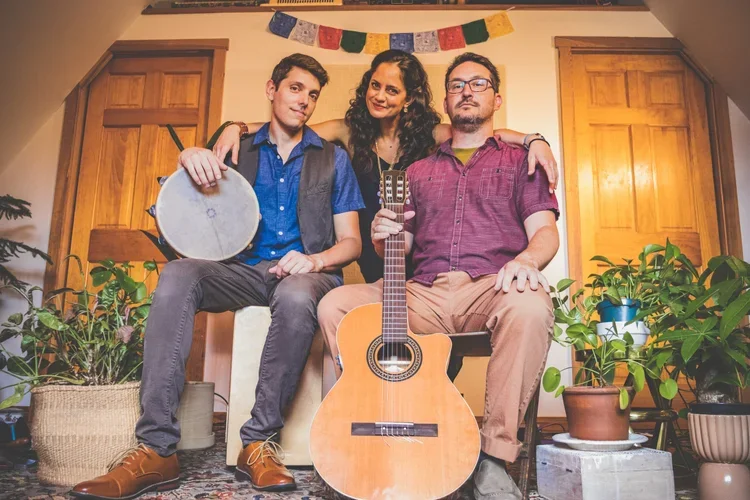
Alla Boara
Tutti sono felici! Italian folk songs receive joyously jazzed-up rearrangements in Alla Boara’s new album Tessere
New York, NY (For Immediate Release) – Adhyâropa Records is thrilled to announce Tessere(ÂR00188), the new album by the dynamic Italian-American folk ensemble Alla Boara. Working from Alan Lomax's extraordinary 1954 field recordings of Italian regional folk songs, Alla Boara creates something vibrant and contemporary by suffusing the original source material with modern jazz sensibilities and global influences, creating a unique sound rooted in tradition but facing the future.
“I founded the band about five years ago as a way to explore my musical heritage,” band leader Anthony Taddeo says. “As the son of an Italian immigrant I’ve always been very proud of my ancestry but it wasn’t until I started doing research into the incredible archive of recordings Alan Lomax left us that I was inspired by the diversity and beauty of my culture to create something that would add to the generational conversation of Italian folk music. And in doing so, for the first time as a musician, I felt connected to this tradition in a real and profound way. But moreover, I discovered the innate humanity that binds all traditions together through the expression of their folk music. If there was ever a time when we all needed to be reminded of our common humanity, it’s the time we’re living in right now.”
The ensemble includes Taddeo on percussion and features the powerhouse Amanda Powell on vocals, along with Dan Bruce (guitars), Mark Micchelli (accordion, piano), Tommy Lehman (trumpet), and Ian Kinnaman (bass). Their interplay is evident from the first notes of the album, ‘Che Bera Sta Figghiola,’ a sprightly tarantella that pops and fizzles with energy, vocal harmony, and instrumental virtuosity, propelled in particular by Taddeo’s incendiary drumming and Powell’s punchy vocal performance. Originating as a mother’s song, bouncing a baby on their knees, here is utterly transformed by an angular, jazzy arrangement that joyfully skips through time signatures and improvisations.
Taddeo speaks of the music of Alla Boara from a broad yet acute philosophical perspective: “Our first release (2022’S Le Tre Sorelle) was really a passion project, I had no idea it would gather as much momentum as it has for the past five years. Our second record (2024’s Work & Song) was a live album, because we wanted a document of the energy we bring to our performances, something that we all felt was very special. But now that we’re releasing this, our third album, we’ve really come to understand how connected people are to this music – even people who don’t understand what we’re saying! – because they can still feel the storytelling and the link to something ancient, the highs and lows of the human experience that are built into all folk musics from around the world.”
The following tracks bolster this perspective and profound universal connection. ‘Maggio Delle Ragazze’ is a traditional Northern Italian spring celebration song, wherein young men parade through streets distributing ribbon-adorned branches in exchange for alms, culminating in a communal feast. It’s not hard to imagine Taddeo’s tambourine and Powell’s clarion voice at the fore of a street parade, supported here by a virtuosic turn from guest violinist Yaryna Tsarynska as well as Lehman’s trumpet, winding through narrow streets before opening up into a grand fête, the ensemble whooping and twirling as the celebration carries on into the night. The following track ‘Jesce Sole’ is one of the oldest pieces in their songbook, though the arrangement is nothing if not modern. Centuries-old, and sung to this day (in its more traditional form) in Naples, here is transformed with electric distortion and even a rock backbeat, with double-time drums and a layered vocal arrangement reminiscent of Becca Stevens or Camila Meza.
“As a composer and arranger, my biggest challenge is, how do I write and arrange these songs in a way that bridges the communication gap. Because even if you're Italian and you come to one of our shows, you probably still don't know what these songs are saying, because they're in all these different regional dialects from around Italy. The diversity of Italian folk music is overwhelming; because of Italy's late unification, you had all these different regions acting essentially as separate countries, and each developed their own folk traditions, music, and dialects that are often different enough from one another that they might as well be different languages.”
The mid-album centerpiece is ‘Questa Mattina,’ which begins with a reverb-drenched rubato before yielding to a slow, inexorable melodic statement for accordion and trumpet played rubato below a sultry, dagger-in-the-teeth vocal performance, building to a massive ensemble of multitracked, wailing electric guitars in 6/4, a slow burn Radiohead would be proud of. At nearly 9 minutes it’s the longest track on the album, each moment building upon the last to its ecstatic conclusion. “The field recording that inspired this piece was captured while men were singing a call and response song to one another as they broke rocks in the middle of a dusty street in Puglia,” Taddeo says. “The arrhythmic hammering of the rocks was sampled for the sound effects in the intro.” Even at its most modernistic, Tessere keeps its feet in rich, fertile Italian soil.
“Growing up as an Italian-American, you're very proud of the food, and the culture, and the dream of the Mediterranean lifestyle,” Taddeo says, “but it always seemed so strange to me that we don’t make more of an effort to preserve our powerful folk art tradition. The context has changed, but the power and universality of its message will always remain. Many young Italian-Americans have never seen what it is to be an immigrant in America. But it became important to me to rediscover this load-bearing part of my heritage, my culture, everything that went into making me who I am. I’ve come to know that that’s an experience which is shared by just about everyone, across cultures. My dad wasn't a citizen until he was 50 years old and supported a family his entire adult life as an immigrant with a green card. This is a beautiful, profound part of the American experience. I celebrate this, I treasure it. This too is something many of us have lost sight of.”
‘Mare Maje,’ another standout track, is an Abruzzese folk song expressing the sorrow of lost love. Grief, it becomes evident, is a common denominator of worldwide folk music. “If nothing else, we try to encourage the audience to sit in this moment with us, and recognize the fact that there are a lot of people that are grieving, that are going through pain currently. In a certain sense, the act of performing folk music is a path to empathy. Different cultures have different ways of grieving, and different ways of expressing their grief. There's no one right way to grieve. This music is a call to spend some time sitting in that fact, and to recognize that people are hurting around us, and maybe even make us think about what we can do to help them, to be loving to them. In this particular climate, our job as an ensemble and as artists is to present this opportunity, this path to empathy. We have an amazing opportunity to present this idea of togetherness and empathy and humanity, and if we're not doing that as artists, I think we fail our audiences.”
A late-album standout is ‘U Leva Leva,’ here called a “reprise” as a callback to its earlier inclusion on their previous release. Micchelli here leads the way with a polytonal deconstruction of form and harmony under a chanted ensemble vocal and Taddeo’s jangly drums. If you closed your eyes, you’d be hard pressed to pin this as one or the other of Italian music or Kamasi Washington.
“We’re focused on trying to create something a bit more universally accessible, with something of a more global sound that opens the door for new listeners. One of my biggest goals is to demonstrate this diversity and this beauty of these folk traditions, but I hope that we in turn inspire other people to want to dig into their own musical heritage as a source of creative ground in which they can cultivate new things. In that act, we can find some things that are really surprising that inform us a lot about who we are. Music has always been a means to relationships and community, and whatever I can do to widen that circle, to embrace more people, to invite them in, is what I want to do with our music. I think that this album encapsulates not only our entire journey and mission as an ensemble, but also is an invitation to come in and be a part of what we're doing.”Tutti sono felici! Italian folk songs receive joyously jazzed-up rearrangements in Alla Boara’s new album
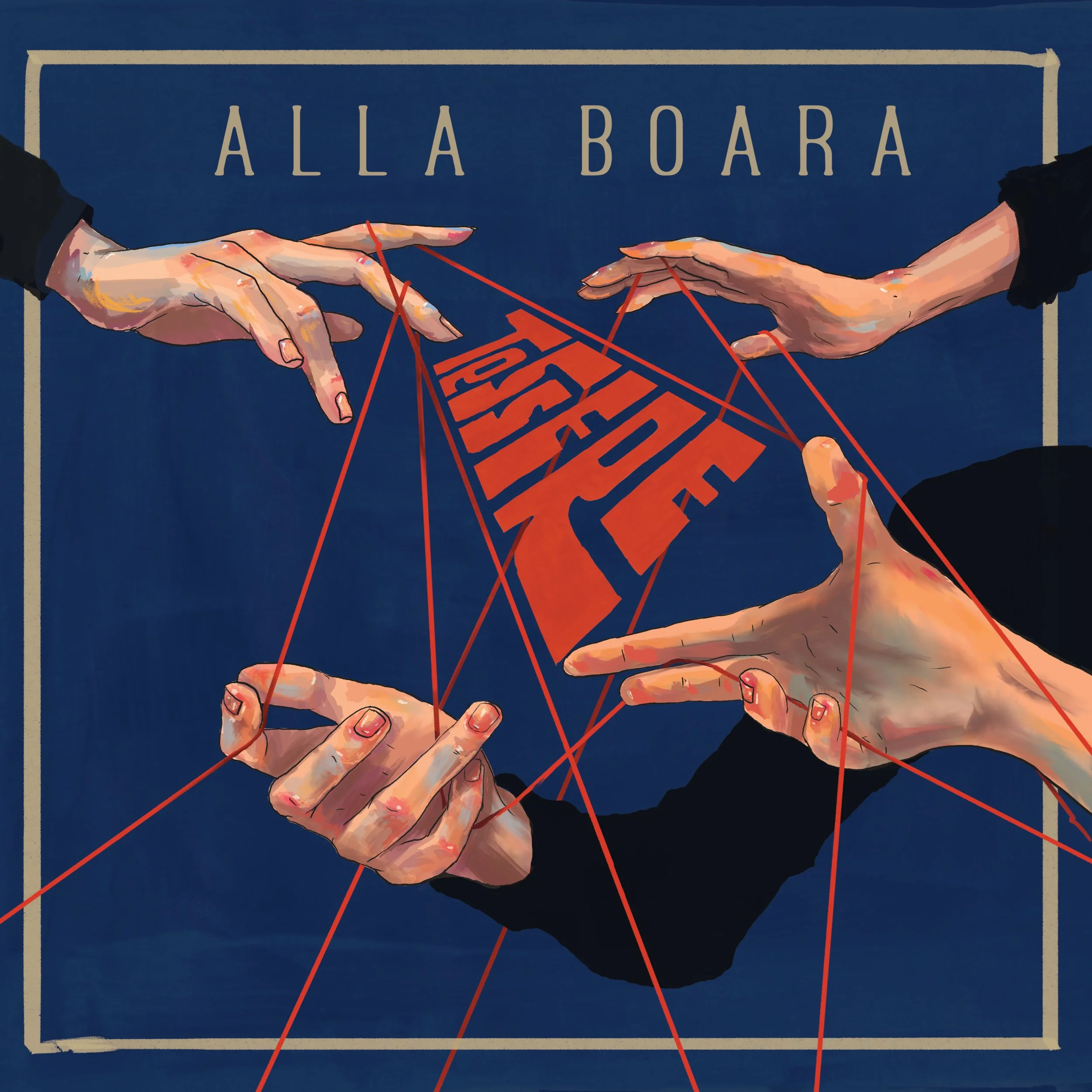
Artist: Alla Boara
Album Title: Tessere
Label: Adhyâropa Records
Release Date: August 4, 2026 (single: ‘___’); August 19, 2026 (single: ‘___’); September 4, 2026 (album: Tessere)
Purchase: https://allaboara.bandcamp.com/album/tessere
Performers: Anthony Taddeo (percussion, vocals, compositions); Amanda Powell (vocals); Dan Bruce (guitars); Mark Micchelli (accordion, piano); Tommy Lehman (trumpet, flugelhorn, vocals) Ian Kinnaman (bass, vocals); Yaryna Tsarynska (violin); Caitlin Hedge (violin)